%20LinkedIn%20page%20(2).png)
Why Replacing Referrals With LinkedIn Is Not Pipeline Ownership

Updated: Aug 20
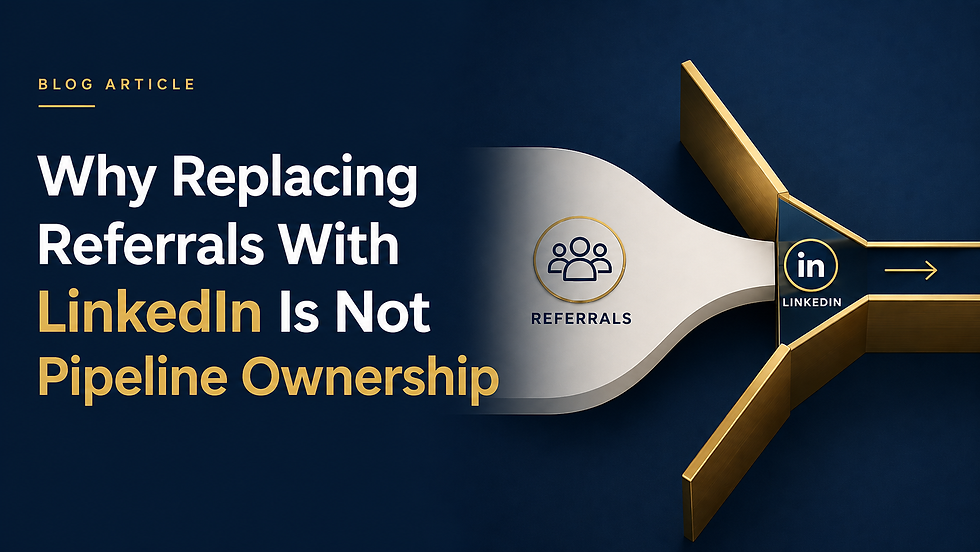
Replacing referrals with LinkedIn is not Pipeline Ownership because the firm remains dependent on a single channel it does not control. Pipeline Ownership requires multiple independent acquisition channels, an owned audience and CRM, revenue targets for each channel, and operating mechanics that allow the firm to continue generating qualified demand when any one source weakens.
Professional services firms are told to fix Referral Dependency by getting active on LinkedIn: clarify positioning, post consistently, build an audience, start conversations, move prospects into calls.
This can work. It can also create a new dependency.
The firm stops waiting on referral partners and starts depending on a social media platform, its algorithm, and the founder's daily activity. That is not a fix, it is swapping one concentration risk for another.
Concentration Risk is when most of your revenue comes from a single channel or source.
A firm can get 80% of its clients through referrals, or six months from now, 80% through LinkedIn, and still be sitting on the same structural weaknesses underneath:
expertise that is hard to evaluate
services compared mainly on price
a founder-dependent sales process
weak proof, slow client replacement
revenue concentrated in a few accounts
no owned database
no repeatable campaign infrastructure
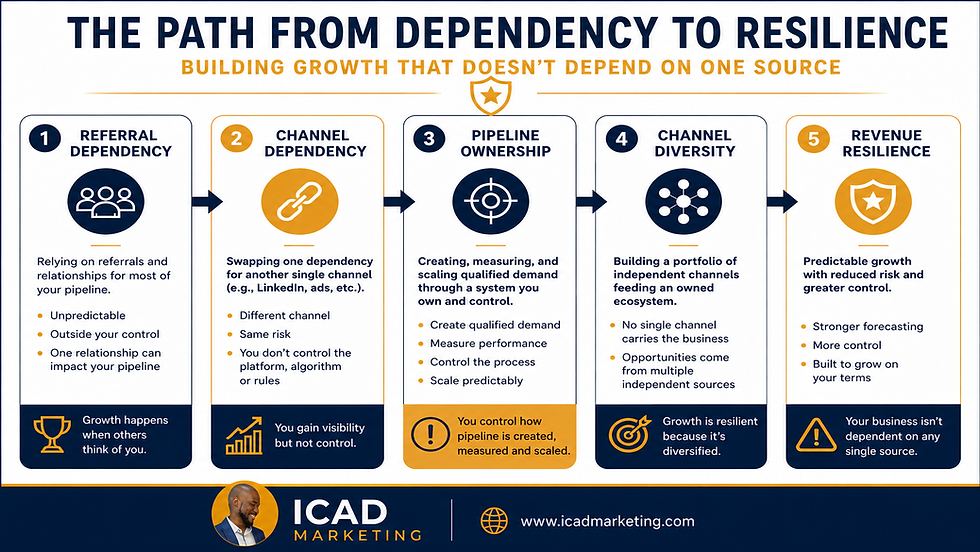
The real issue was never referrals, it is the dependency on them. Therefore, relying on another single channel simply transfers that dependency, in this case Channel Dependency.
The answer to Channel Dependency is not a better single channel. It is Channel Diversity. Creating enough acquisition resilience that no one channel, platform, or referral relationship can decide when the firm has sales opportunities or whether the firm grows.
Channel Diversity is the product of Pipeline Ownership. This is a firm's ability to create, measure, and scale qualified demand and pipeline through a system it owns. LinkedIn can be one channel inside that system. It should never be mistaken for the system itself.
The Mistake: Treating Referral Dependency as a Channel Problem
Referral Dependency usually gets diagnosed as a lead-generation shortfall: the firm doesn't get enough leads outside referrals. That is a symptom, not the underlying issue. The same that LinkedIn can become the underlying issue to growth, becoming a single point of failure in a firm's demand engine.
The typical arc: referrals feel unpredictable → founder starts posting on LinkedIn → engagement grows → DMs turn into conversations → a few clients close → LinkedIn becomes the primary source of opportunity → founder concludes the referral problem is solved.
However, it is not solved. The firm now depends on one platform, one algorithm, one profile, one outreach method, and one person's availability. That's the exact same risk profile as Referral Dependency, concentrated, fragile, and outside the firm's control.
The name of the channel changed. The underlying vulnerability did not.
A LinkedIn profile is not an owned audience. Followers, connections and newsletter subscribers exist inside infrastructure LinkedIn controls.
LinkedIn determines:
Who sees a post
How content is distributed
Which formats receive greater visibility
How many connection requests can be sent in a week
Which accounts are restricted because of a violation
Which automation tools are permitted
How much historical content remains discoverable
A firm can build meaningful visibility on LinkedIn, but it cannot control the platform. That distinction matters.
This is why Channel Diversity and Pipeline Ownership has to be the goal from the outset, not a "someday" upgrade once LinkedIn or referrals stop working. A firm that builds only one new channel to replace the old one has not solved Channel Dependency, but simply recreated it.
Pipeline Ownership Creates the Infrastructure Channel Diversity Runs On
Diversification only works if the relationships it creates do not stay trapped inside whichever platform generated them. A LinkedIn connection is commercially fragile until it moves into infrastructure the firm actually owns: a permission-based email list, a structured CRM, webinar registrants, etc.
This owned layer is what makes true channel diversity possible, because it is the one asset that survives any single channel's decline.
If LinkedIn reach falls next quarter, a firm with an owned list, CRM, and nurture sequence can shift weight to email, or launch a re-engagement campaign with stalled deals and inactive prospects, without starting from zero.
A firm with only a LinkedIn following has nothing to fall back on. The owned audience is not a nice add-on to the pipeline. It is the backbone that lets diversity actually function under pressure.
Here are several ways to think about and build Pipeline Ownership and Channel Diversity.
1. Build a Portfolio of Genuinely Independent Channels
Create a real portfolio of channels that draw from several independent pipeline sources:
Owned Audience Channels: Email newsletter, Private community or membership, Webinar event and resource registrant database
Controlled Outbound Channels: Targeted email outreach, Account-based campaigns, Direct mail campaigns, Telephone outreach
Owned Conversion Channels: Diagnostic tools, assessments, calculators, and scorecards, Lead magnets connected to automated follow-up, Pre-Qualification funnels
Owned Event Channels: Firm-hosted webinars and workshops, Executive roundtables, Recurring educational series where the firm owns registration data
Reactivation Channels: former clients, dormant leads, past proposal-stage prospects, Lost opportunities

Each requires a different strategy and approach, but should all create a cohesive pipeline a firm can pull from.
The firm does not need all of these running simultaneously. It needs to know which two or three are active now, which are being built next, which serve as backup if a primary channel weakens, and which to abandon if it no longer serves the firm.
The test for a healthy portfolio: if any single channel dropped to zero next month, would the firm still hit pipeline coverage to hit our revenue targets?
2. Run the Revenue Math and Allocate Channels Against It
Pipeline Ownership starts with a number, not an activity level. If a firm wants $1.2M in new revenue at $40K average client value, that is 30 new clients. At a 25% close rate on qualified opportunities, that is roughly 120 qualified sales leads.
At a 50% qualification rate from initial conversations, roughly 240 relevant sales conversations across every channel combined.
Once that total is known, it gets allocated across your high-performing channels:
How many conversations should referrals produce
How many should LinkedIn produce
How many should the owned list produce
How many should direct outreach produce
Each channel now has a target, not just an activity level. That allocation is what turns, "We're doing a few different things" into an actual diversified portfolio running on top of an acquisition system, instead of waiting three months later when revenue is already short.

3. Install the Operating Mechanics That Let a Portfolio Run Itself
A diversified pipeline still needs someone accountable for it, and a small set of mechanics to keep it honest:
Defined stages: identified account, engaged prospect, qualified opportunity, active sales process, proposal, closed, lost, nurture
Entry and exit criteria: clear standards for when an opportunity enters the pipeline and what moves it forward, stalls it, or removes it
Source tracking: every opportunity tagged to the channel that created it, so channel-level performance is visible
A review cadence: pipeline inspected on a schedule, not only when revenue gets tight
This is what separates Pipeline Ownership from a portfolio of randomness. Without it, a firm can be running five channels and still have no idea which ones are actually carrying the business, and therefore which to drop.
The Real Objective Is Control Through Diversity
The goal is not to eliminate referrals and it is not to replace them with LinkedIn. That just swaps one concentration risk for another and calling it progress.
The goal is Pipeline Ownership: a firm that controls how it generates demand and pipeline through multiple independent channels, can scale it when needed, owns the infrastructure those relationships live in, and can rebalance instantly when any single source weakens.
LinkedIn can be one contributor to that system, and referrals can be another. Neither one, alone, is ever the answer.
The ultimate goal is diversity built, controlled and owned by the firm, that does not change regardless of what happens on a platform or channel.


Comments