%20LinkedIn%20page%20(2).png)
Why Accounting Firms and Finance Firms Fail to Attract High-Value Advisory Clients

Accounting firms and Finance firms struggle to attract high-value clients primarily because of a positioning problem, not a service quality problem. When firms describe themselves through services and deliverables such as, bookkeeping, tax preparation, cash flow forecasting, strategic advisory, they give buyers no way to evaluate expertise, judgment, or strategic value. Therefore, buyers default to comparing on price and scope, which disadvantages firms doing more sophisticated work and drives them toward transactional, wrong-fit clients.
This is what we at ICAD Marketing call the Value-Perception Problem: the gap between the value a firm actually delivers and the perceived value a buyer can recognize from the outside. The fix is not better marketing or more detailed service descriptions. It is a deliberate positioning strategy that names a specific buyer you serve, a specific problem you own, and helping buyers understand the consequences if that problem is left unsolved.
The Market Shift Most Firms Never Account For
In 2022, two years after launching ICAD Marketing, I noticed a pattern I had not paid much attention to in the past.
For the first two years, I had positioned ICAD as a Content Marketing agency. It worked for a while, until the market shifted around me.
Most agencies stopped calling themselves "Digital Marketing" agencies, as was the dominant label of the 2010s, and started calling themselves "Content Marketing" agencies. The new label gained traction, but what most of these firms were actually doing was:
Posting on social media (Social Media Marketing)
Writing blog articles to rank on Google (SEO Marketing)
Creating content optimized for engagement and virality (Brand Awareness)
All good tactics, but none individually truly encompass what content marketing really is. The result was the market became saturated with agencies using the same label to describe meaningfully different things.
Three things happened simultaneously:
1. Increased supply - made it harder than ever to stand out because the category itself became crowded.
2. Firms with shallow expertise diluted the category frame - buyers who hired "Content Marketing" agencies whose expectations were not met stopped trusting the label.
3. That dilution meant buyers were evaluating with the wrong criteria - unable to distinguish between surface-level execution and deep strategic work, compared on price.
I spent most of my sales calls explaining what content marketing actually is, justifying my prices, or chasing prospects who could not understand why my work cost more than the agency that just posted on memes and 'boosted' posts on social media.
Winning on expertise and past results alone was no longer enough. The market did not understand the value I could deliver relative to others, because the frame buyers were using to evaluate the category was broken.
I share this story because the same pattern is now playing out across almost every professional service vertical, specifically accounting and finance firms.
Why This is Important to Accounting Firms and Finance Firms
The structural dynamic I experienced in marketing now exists in your market.
The supply of providers claiming similar expertise has expanded significantly. The frames buyers use to evaluate accounting and finance services have become confused by that expansion. The result is a market where genuinely capable firms are being evaluated alongside providers doing fundamentally lower-value work, and losing to them on price.
Consider how the category lines have blurred:
Bookkeepers are being confused with Fractional CFOs - buyers who hired Bookkeepers expect advisory work at the same price.
Traditional Accounting firms are moving into advisory services - without repositioning how they describe what they do so buyers understand the new frame.
CPA firms are competing with freelance tax providers - whose pricing is built on a completely different cost structure and scope
CAS firms are essentially invisible to buyers - because almost no one outside the industry knows what "Client Accounting Services" actually means.
When the category frame breaks down and your firm gets grouped into the same box as every other provider using similar language, two things happen:
The wrong-fit clients keep showing up
The right-fit do not see you as relevant
No amount of networking, content production, or proposal refinement fixes this, because the problem is not about activity or execution, it is a positioning problem. Positioning is what determines which buyers see themselves in what you offer, and which ones do not based on what you are known for to a specific segment.
Why Explaining Your Services in More Detail Makes It Worse
The natural instinct when buyers do not understand your value is to describe your work in more detail.
More services listed, longer service pages, and more detailed proposals. Clearer breakdowns of what is included.
This approach fails because it is counterintuitive.
When a firm leads with services, it hands the buyer a specific evaluation frame: "I should compare this firm by scope and price". More detail about services gives the buyer more things to compare within that same frame. It does not change what they are comparing against. It deepens the problem.
Here's what a buyer sees when they visit most accounting and finance firm websites:
Bookkeeping
Tax preparation
Cash flow forecasting
Strategic advisory
Fractional CFO services
Now consider that every competing firm's website, from the solo practitioner to the regional CPA firm to the freelance bookkeeper, says almost exactly the same thing.
The buyer has no way to evaluate expertise, judgment, or strategic value from a services list. So they do the only rational thing available to them: they evaluate on price and scope.
This is the Value-Perception Problem. It is the gap between the value a firm actually delivers and the perceived value a buyer can recognize from the outside. It is a positioning problem that typically shows up consistently in the complaints firm owners describe most often:
"Prospects compare us on price instead of our expertise and effort"
"I keep attracting clients who want compliance work, not advisory"
"I post content and get engagement from peers, but no client inquiries"
"I quoted my standard monthly fee and they said it's too expensive."
These are not four separate problems. They are four symptoms of the same root cause: the market cannot see the difference between what you deliver and what a cheaper alternative delivers.
Two Stories That Show Exactly What This Costs
The Bookkeeping cleanup that was not "Just Bookkeeping"
A firm owner I spoke with had a sales conversation with a qualified prospect who needed monthly bookkeeping support.
Before ongoing bookkeeping could begin, years of tangled records needed to be addressed. Misclassified transactions, and unreconciled accounts work before ongoing bookkeeping services could be delivered.
When the firm delivered the scope and price, the prospect pushed back immediately.
"Why does this cost so much? You're just doing bookkeeping."
From the prospect's perspective, bookkeeping and cleanup were the same thing.
From the firm's perspective, the engagement required:
Identify years of misclassified expenses creating tax exposure the prospect did not know they were carrying
Reconstructing a financial picture that would finally make the business' actual performance visible to its owner
Building a foundation that would make every future decision — hiring, investment, pricing — grounded in real data instead of guesswork
The prospect saw an overpriced line item. The firm saw the level of work it would take just to get the books to a state where ongoing bookkeeping made sense.
The Fractional CFO Priced Like an Accountant
A similar story of diluted frame creating a value perception problem was a Fractional CFO I spoke with.
They mentioned that a prospect they had a sales call with wanted to pay what their previous Accountant charged.
That former Accountant was charging per year what the Fractional CFO charged per month, for the same service. Not because the Fractional CFO was overpriced, but the former Accountant created a false expectation of the level of work, pricing and delivering that level of service would take.
The prospect had no frame to distinguish between them, because both the accountant and the Fractional CFO described their work using similar language.
The former accountant did not just set a pricing expectation, they had set a value expectation. That expectation was wrong for the level service the Fractional CFO was providing.
This is what a broken category frame does at the individual firm level. It imports false value expectations from adjacent providers, and puts genuine experts in the position of either discounting to match those expectations, or losing the engagement.
The Shift That Actually Changed Things for Me
When I recognized that explaining my work in more detail would not move buyers, I stopped competing within the broken frame and changed my approach entirely around how I was positioned so it did not dilute my expertise.
Step 1: Stopped Fighting the Existing Market Frame
Rather than wasting time on sales calls explaining what content marketing actually is and why it was worth more than social media posting, I accepted that the frame was broken and decided to reposition outside of it.
You cannot win a perception battle by explaining your way out of it. You win it by changing how and what you are being compared against.
Step 2: Changed How My Value was Perceived (Value Reframe)
I did a competitive analysis across the entire market, looked at how other firms in my space were describing themselves, then asked the question, “How can I position beyond simply Content Marketing using my expertise in a way the market would find valuable?”
Step 3: Got Specific on Who I Served
It is nearly impossible to build authority with a broad audience, because authority is specific by definition. I focused on the audience I could best serve, which evolved over time.
First marketing leaders, then business owners, then service businesses, and eventually professional service firms. Each narrowing made the positioning stronger and the right clients easier to recognize.
Step 4: Identified the Problem Worth Owning
Most positioning work focuses on what the firm wants to offer. The more useful question is: what problem does this specific audience most need solved, and what does it cost them to leave it unsolved?
I conducted interviews, hundreds of LinkedIn conversations, and online research to understand what the people I wanted to serve were actually struggling with, not what I assumed they were.
Step 5: Named and Owned the Problem
Once I understood the real problem, I built a named concept around it, one I could position around, publish consistently, and own. The positioning and the content became mutually reinforcing. Each piece of content deepened the market's association between my firm and the specific problem I was built to solve.
What The Shift Looked Like for a Financial Advisory Firm We Worked With
I worked with a Financial Advisory firm owner experiencing the same problem. Strong delivery, real expertise, and a positioning problem that was making both invisible.
Before the positioning work:
Struggled to differentiate from other firms
Did not know the best way to position to attract high-value clients
Posted content with zero inbound leads/inquiries
Prospects saw them the same as other advisors
After:
Clarified exactly who their target niche should be
Improved positioning through client and market data
Content started driving inbound leads by week two
Signed 4 advisory clients first month
Generated over $200K in pipeline (half converted to revenue)
Currently seen and expanding as the go-to expert in their niche
Read the full case study and his results: How a Financial Advisory Firm Built a Stronger Pipeline They Control.
Three Signs Your Firm Needs Positioning Work to Attract High-Value Advisory Clients
Not every firm needs to do this work at the same moment. However, there are three situations where it becomes the highest-leverage move available.
1. Your Market Has Become Overcrowded and Undifferentiated
Every firm in your space is using the same language, the same service labels, and the same positioning claims. Your website reads like your five closest competitors. Buyers cannot tell the difference between you and them when searching online.
When this is true, more content, more networking, and more proposals produce more of the same ineffective results, because the underlying positioning has not changed. A deliberate reframe creates separation by naming a specific problem other firms are not naming or intentionally owned, and building a position around that frame rather than around a service category.
2. You Are Struggling to Convert Qualified Buyers
Leads arrive but stall, or they convert only after discounting, and for work that does not reflect the full depth of your expertise. Compliance work instead of advisory. Hourly fees instead of value-based retainers. Seasonal engagements instead of ongoing relationships.
When qualified buyers consistently cannot see enough value to justify premium pricing, the issue is upstream of the sales conversation. The reframe makes value visible before the first call happens, so price stops being the deciding factor in the room.
3. You Are Trying to Move Upmarket
The positioning that attracts a $500/month compliance client will not attract a $5,000/month advisory client. These two buyers have different growth stages, different decision-making criteria, different language, and different definitions of what "value" means in a professional services engagement.
Moving upmarket is not a pricing decision, it is a positioning decision. It requires reframing what you offer in language that advisory clients understand, trust, and recognize as relevant to their specific situation. Not just repurposing the same messaging and offer at a higher price point.
How Accounting Firms or Finance Firms Position to Attract High-Value Advisory Clients
The positioning work described here is not a one-time messaging exercise. It is the structural foundation that every other part of client acquisition builds on.
Get it wrong or skip it and everything downstream is harder than it should. More content, more calls, more proposals, more discounting, wrong clients.
Get it right, and the best-fit clients begin self-selecting before you have spoken a word to them. The work that arrives matches the expertise you have built. The price conversations shift, and even referrals improve because referral sources finally understand clearly who to send.
This follows a specific sequence. Each step builds on the one before it.
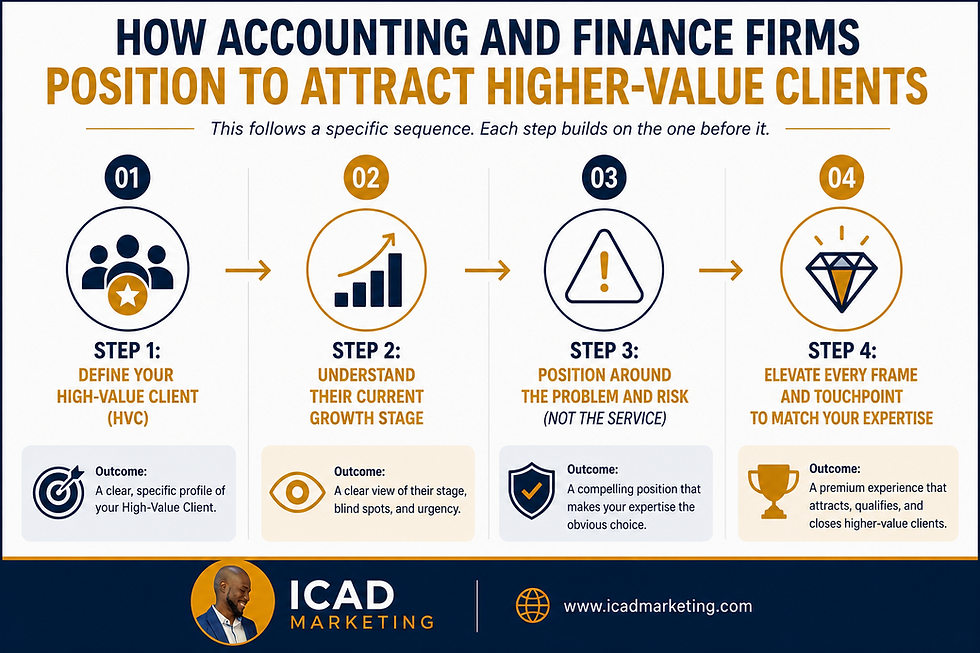
Step 1: Define Your High-Value Client (HVC)
Most firms define their target client by size, revenue, or industry. That is not specific enough to build positioning around.
A High-Value Client profile goes deeper. It identifies the type of buyer whose situation, growth stage, and financial complexity makes your expertise specifically relevant and valuable to them.
Not every business owner. Not every finance professional. The specific person, at a specific moment in their business or career, carrying a specific problem your firm is built to solve.
The outcome: A clear, specific profile of your High-Value Client, one that shapes every downstream decision about messaging, content, outreach, and what you say yes and no to.
Without this, positioning is built on assumptions and whoever is willing to pay, rather than on who actually produces your best work and your best results.
Step 2: Understand Their Current Growth Stage
The same buyer at different stages of their business has completely different needs, different blind spots, and a completely different threshold for urgency.
A business owner in early growth is managing cash flow day to day. A business owner approaching a scale inflection is worried about the financial infrastructure their growth is about to outrun. A founder approaching an exit has a completely different set of financial decisions in front of them than either of the others.
Each stage comes with specific blind spots, the risks accumulating without the owner's awareness, and specific urgency. Positioning that speaks to one stage often fails to resonate with another, even when the service being offered is identical. Which is why choosing one client-type and building your positioning around their specific growth stage is important.
The outcome: A clear view of your High-Value Client's current stage, the blind spots they are carrying, and what creates urgency for them right now.
Step 3: Position Around the Problem and Risk (Not the Service)
This is the step most firms skip, and the one that creates the most differentiation when done correctly.
When an Accounting firm or Finance firm leads with services, it forces a comparison on scope and price. When it leads with the specific problem a specific buyer is facing at a specific stage, and the cost of leaving that problem unsolved, it changes the evaluation frame entirely.
The buyer stops asking "How much does this cost?" and starts asking "Can we afford not to solve this?"
This means describing:
The costly problem your High-Value Client is carrying at their current growth stage
Why their current approach is creating risk they may not be fully aware of
What it costs them to leave it unsolved (financially, operationally, and strategically)
Why your firm specifically is built to solve it in a way others are not
The outcome: A compelling market position that makes your expertise the obvious choice for the right buyer, because you named their situation more precisely than anyone else has.
Step 4: Elevate Every Frame and Touchpoint to Match Your Expertise
Positioning does not live on the website alone. It runs through every interaction a buyer has with your firm. The content they see before they reach out, the discovery call, the proposal, the onboarding experience.
If the positioning says "premium advisory partner" but the discovery call feels like a commodity vendor conversation, the positioning has not actually changed anything.
The gap between how the firm describes itself and how it shows up is where positioning breaks down in practice.
Elevating every touchpoint means ensuring that:
Content demonstrates how you think about buyer problems, not just what services you offer
The discovery call begins from a place of diagnosed expertise, not a generic intake form
Proposals reflect the buyer's specific situation and the cost of their problem, not a scope and price list
The client experience, from first contact through delivery, signals the same level of expertise the positioning promises
The outcome: A premium client experience that matches your "value frame", and attracts the right buyers, qualifies them before the first call, and closes higher-value engagements without requiring discounting or extended convincing.
We Built the Solution for Accounting Firms and Finance Firms Wanting to Attract High-Value Advisory Clients
This is the exact positioning sequence built into ACE — the Advisory Client Engine — ICAD Marketing's done-for-you system built specifically for Accounting firms, Fractional CFOs and Finance firms ready to stop competing on price and start being recognized for the expertise they actually have.
ACE closes the Value-Perception Problem at its root build the client acquisition engine that attracts higher-value advisory clients:
A High-Value Client profile grounded in real client interview data, not assumptions
A positioning strategy built around the problem your best clients recognize as urgent and costly
Framing that makes your value immediately legible to the right buyers, before the first conversation
A client acquisition system that attracts advisory-level clients consistently, without depending on referrals or price-based comparisons
If the wrong clients keep showing up, or the right ones are not converting at the level your work deserves, the problem is upstream of everything else you are doing.
ACE is where that gets fixed.


Comments